- The Lazy Reader
- Posts
- "As if searching for something lost."
"As if searching for something lost."
PLUS: Gay tech bros, hypothermia, and the world's biggest retail brand,

In partnership with

Hi 👋
Another Monday, another longform reading list from The Lazy Reader ✨
I can’t believe it’s already March. Q1 is almost over. 2026 has so far been a blur of nauseating news, the threat of war, and never-ending deadlines. It’s a surprise we’re all still here, honestly. And I hope amid all of that, TLR has been giving you enough of a respite. I know longform journalism might seem like an odd choice for an escape from “real life,” but if it works, it works!
Anyhoo—some choice picks from last week’s newsletter:
The New York Times A Brutal Sex Trade Built for American Soldiers
The Atlantic The Death of an Adjunct
The San Francisco Standard How One Judge’s Decision Led to a Child’s Abduction — and Exposed a Broken System
As with last week, please let me know what you think of the list this week by voting in the poll below.
Happy reading and see you again next Monday!
PS - Thanks to Celluma and Masterworks for supporting this week’s newsletter! Please, please consider clicking their ad links below. It’s free, easy and helps me out a lot.
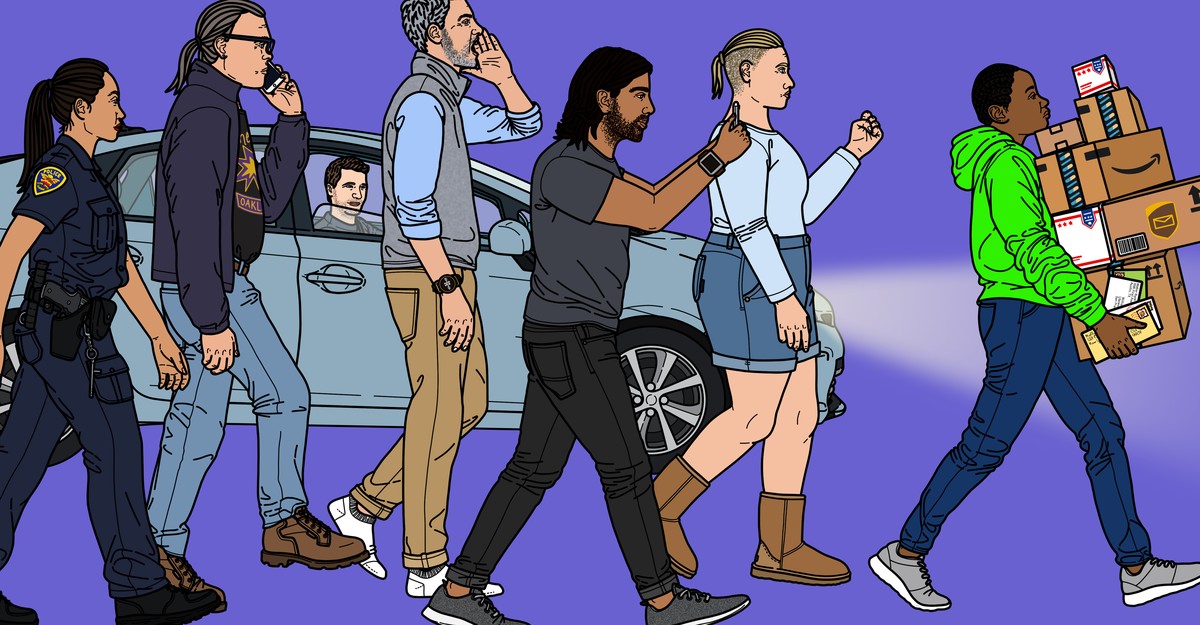
Given The Atlantic’s recent reputation of conservative centrism, this story was a pleasant surprise.
On the surface, this story just follows the story of someone who swipes Amazon packages and deliveries from neighbors’ doorsteps. But you won’t have to dig too deep to see that there’s an undercurrent here of class, poverty, privilege, gentrification. All very complicated subjects that I think, given the confines of the article, was addressed reasonably well.
I didn’t expect The Atlantic to actually go to the roots of petty theft. An outlet that’s very comfortably upper-middle-class wouldn’t have taken that analysis. But, in my opinion, that’s 100% the correct lens to use in this case. The porch pirate here, as the headline calls her, has lived in the community for a long time but was ultimately priced out of it. Coming to replace her was a more affluent class of residents—those who’d spend more than her month’s earning for a smoothie.
With this as context, it’s not difficult to empathize with the thief. And if you go a step further, it’s also not far-fetched to see her crimes against the backdrop of even bigger transgressions, such as real estate speculation and price inflation. It’s always just obscured from view but justice and legality are often used as fronts for oppression.
Inside the Gay Tech Mafia | WIRED, $
Another one of those hyper-viral stories that I felt just had to make it to the newsletter. WIRED here investigates the seeming predominance of gay men at the highest echelons of Tech (a pretty fraught premise, I admit) and tries to get at the bottom of this alleged mafia (also a fraught moniker). This piece is very interesting, which is good because it at times goes a bit too far into some homophobic territories, I think.
But there is a very apt point buried under all the innuendos here: That power flows asymmetrically, even if those that hold it typically belong to marginalized groups. Groups of gay men in this story very clearly only reward those that they find physically (or sexually) attractive. Women are completely sidelined. I think that should have been the focus of the story.
Uniqlones | New York, $
More than a decade later and it’s very interesting to see how much of this story still rings true. I haven’t checked how far Uniqlo’s sales have gone, but it’s not a stretch to think that the company has only grown. Even in my backwater Global South market, the brand has grown insanely popular.
This story approaches Uniqlo’s massive success with a certain level of incredulity that, in some parts, can feel a bit exclusionary, or that it minimizes the brand’s success—as if the only commercial models that should be working is those that U.S. companies use. Though I concede that I might be reading a bit too closely into that…
Regardless, the piece does an incredible job of chronicling the rise of Uniqlo and taking stock of what makes a giant Asian retail empire tick. Would love an updated version of this for 2026.
Frozen Alive | Outside, Free
There’s been some talk recently about how a certain measles article from The Atlantic crossed into some questionable journalistic waters because the writer allegedly fictionized the story to get the point across.
I understand the critique, especially since it soon became clear that the made-up family in the piece wasn’t a good statistical representation of who typically denies vaccination. Still, I think there’s a place in journalism for that type of storytelling. This piece, from Outside, shows the possibilities: It narrates a completely made-up scenario of a person going out in winter and, through a series of mishaps, suffers from life-threatening hypothermia.
Did this entire episode actually happen? No. Does that mean that this story is fictional? Probably. But it’s nevertheless grounded on truth, I think. The way the body reacts to the cold, the temperature thresholds, the series of chemical and biological reactions—those are all fact.
How did you like this week's list? |
Most anti-aging devices are expensive placebos. This one isn't.

Red light therapy sounds like wellness bullsh*t. We get it.
But Celluma is the only LED brand with 5 FDA clearances, not just for wrinkles, but also pain relief, hair growth, body contouring & more. Clinical trials showed 80% improvement in skin texture and a 66% reduction in wrinkles after 4 weeks of consistent use.
Most LED devices don't have the power density or wavelength precision to actually do anything. Celluma does. With proprietary processor-driven algorithms that deliver proven results, plus a patented design that shapes around your face, scalp, or any body part. No needles, no downtime, no Botox appointments.
The only catch? Consistent use. This isn't a one-and-done fix. It's mitochondrial support for your skin & entire body, a fancy way of saying it helps your cells do their job.
If you're already spending money on anti-aging stuff anyway, at least try something with actual clinical backing.
Results vary. Consistency required. FDA-cleared for specific indications.

This piece is about a brave and irreverent Pakistani journalist who ruffled a lot of high-powered feathers, ultimately resulting in his murder. The writer here does a heroic job of parsing through Pakistan’s intelligence community and trying to figure out where terrorist groups may have had some insiders, and the story itself is a gripping tale of political intrigue.
Now that I’ve had time to ruminate about it, though, I realize that the piece’s political potency was a bit diluted. I understand that the subject here was incredibly complex and opaque: Pakistan’s intelligence agency, by necessity, is a sprawling and loose coalition of secrets, and its military connections with the U.S. is also largely kept under wraps. Still, I feel like the narrative backbone here could have been given a much clearer focus.
Even the main narrative of the murdered reported (which I felt was a bit shallow) tended to disappear from view many times, leaving me to figure out if it was still about that particular killing, or if the writer would springboard to bigger subjects.
(He didn’t, which was disappointing. There was so much there about the U.S. CIA’s complicity in torture and the U.S. military’s blatant violation of another country’s sovereignty. The writer also at times tries to sully the reputation of the slain journalist by linking him with the terrorist groups, though there never was much evidence to back this up. Makes it feel like the piece had some influence from the military.)
This Woman Gets Students Accused Of Rape Back Into School — For A Price | Buzzfeed News, Free
I won’t lie: I went into this assuming the worst about this woman, and I don’t think I ever really shook that notion. I was wary of her all throughout the story, and would catch myself looking for holes in her character and motivations.
But now that I’ve had the space to think about her work, I admit that her approach is, on some level, clever. Maybe even progressive. She takes a non-carceral approach to crime, which is something that the rest of us could do better about. Reform trespassers, not condemn them for life.
That said, I’m not sure how feasible her approach is—safety-wise, especially, since it could put many other women at risk—or how pure her intentions are. There’s a class dimension here that I felt could have been explored much deeper.
For whatever twisted reason, guns remain massive in the U.S. This piece from GQ looks at a cottage industry of gun-selling that has grabbed the country by the gonads—with fatal consequences.
At the heart of this culture, as this story shows, are people like Dragonman who just don’t give a shit. They believe in their supreme right to do whatever the hell it is that they want to do, and no one should be able to tell them otherwise. The story profiles Dragonman and his gun empire, but I think it’s truly more about the type of psyche that would see the killings continue as long as their whims are catered to.
The Mysterious Disappearance of a Revolutionary Mathematician | The New Yorker, $
Science stories suffer from two common pitfalls: They either become too micro, excessively focused on minute details; or they become too macro, with the writer waxing way too philosophical, flying beyond the confines of the article. This story, about a fundamental figure in mathematics that goes missing, manages to fall into both.
That’s not to say, of course, that this was a bad story. It wouldn’t have made this list if it was. Just to say that these are things that you can expect to encounter while reading this story. Somehow, the writer was able to go closely examining the life and work of this mathematician, to looking at what his life and work mean in the grand scheme of society and the universe. If you’re not prepared for those, this story may be a bit jarring to read.
Ray Dalio: "The S&P Fell 28% Last Year." Wait, What?

He's measuring in gold, not dollars. And that's the point.
The dollar dropped 10% in 2025. So, yeah, your portfolio went up in dollars, but, Dalio says your real return isn’t so exciting.
And the decline is reportedly advancing as macro conditions don’t improve.
So, what investments offer protection against that currency risk?
Well.. billionaires have an answer. And now 70,819 everyday investors have joined in.
This unexpected asset class outpaced the S&P 500 overall with low correlation since 1995.*
Not real estate or PE. Post war and contemporary art. Seriously.
Plus– Art trades globally ;)
And now, you don’t need to be a billionaire–
Masterworks makes it easy to FRACTIONALLY invest in blue-chip art, with a track record of 26 net annualized returns like 14.6%, 17.6%, and 17.8% on works held over a year.
See why investors moved $1.3 billion into 500+ offerings:
*According to Masterworks data. Investing involves risk. Past performance not indicative of future returns. See important disclosures at masterworks.com/cd.
Thanks for reading! Please, please reach out if you have feedback, suggestions, or questions. Alternatively, you can fill out this super quick survey form. I promise it won’t even take five minutes of your time, and it’ll be a HUGE help!
ALSO: I know some of the stories I recommend might be behind paywalls, and maybe I can help you with access to those. Send me a message and let’s see what we can do 😊
Until next Monday! 👋
Reply